The Boat with a Girl’s Heart | Anhinga Press | 2025
Purchase @ Amazon.com.
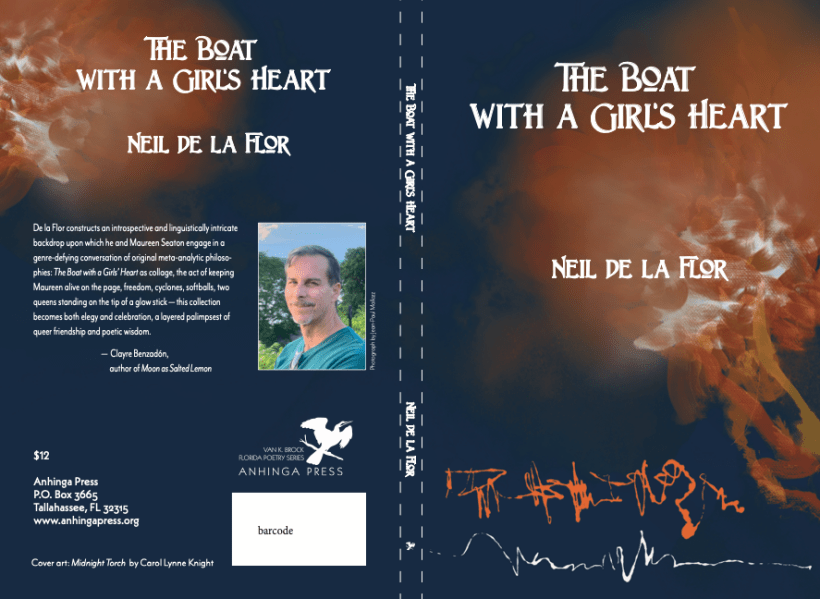
de la Flor constructs an introspective and linguistically intricate backdrop upon which he and Maureen Seaton engage in a genre-defying conversation of original meta-analytic philosophies: The Boat with a Girls’ Heart as collage, the act of keeping Maureen alive on the page, freedom, cyclones, softballs, two queens standing on the tip of a glow stick—this collection becomes both elegy and celebration, a layered palimpsest of queer friendship and poetic wisdom.” — Clayre Benzadón, author of Moon as Salted Lemon
Richly collaged, lush, oft-surprising and highly inventive, this collection by Neil de la Flor glows. The Boy with a Girl’s Heart gives wonderful tribute to collaborator and friend Maureen Seaton and is a powerful love letter to the art of creation and collaboration, especially of poetry that lasts. This collection is heartfelt and touching and sigh-sweet. de la Flor deftly weaves in and out of a “boy’s with a Girl’s” heart and gives us a peek into intimate conversations and flights of fancy. Every line in this magnificent chapbook struck me and shook me down to the core and made me remember that “survival is never pretty” but poetry this beautiful is why we write in the first place. Thank you, Neil de la Flor and Maureen Seaton, for giving us a peek into your relationship, which miraculously mirrors the little shudderings of our own poetic hearts. This one is a gem. — Jennifer Maritza McCauley, author of When Trying to Return Home
The Ars Magna for the Manifold Dimensions of z | JackLeg Press | 2021

Daring and brilliant, Neil De La Flor’s latest book, The Ars Magna for the Manifold Dimensions of z, is a big kick in the rear to absurdist theater. It stars a very tough Meta, a member of the Danish underground. “If my head had been cut off,” says Meta, “you would’ve been next.” The book explores “parallel worlds that are unaware of the other, but are layered on top of each other like minks or foxes wearing stoles and fur coats.” Characters pursue each other through five acts, a series of emails and an epilogue invoking Minkowskian Spacetime – I won’t go there but wow! de la Flor dives deep into meta-Meta-mind. –Terese Svoboda
In The Ars Magna for the Manifold Dimensions of z, Neil de la Flor gives us a braided history of the speaker and his beloved Meta. Through found (sometimes redacted text), memory, interviews and gorgeous speculation, de la Flor conjures a lovingly hybrid picture of Meta and the Danish Underground Resistance during the Holocaust. As the poet learns more about his heritage, we as readers learn more about American families and the pasts they carry, what our elders have taught us and what has (and perhaps always will) remain a mystery. –Denise Duhamel
Reading Queer: Poetry In A Time of Chaos | Anhinga Press | 2018
Purchase > here.
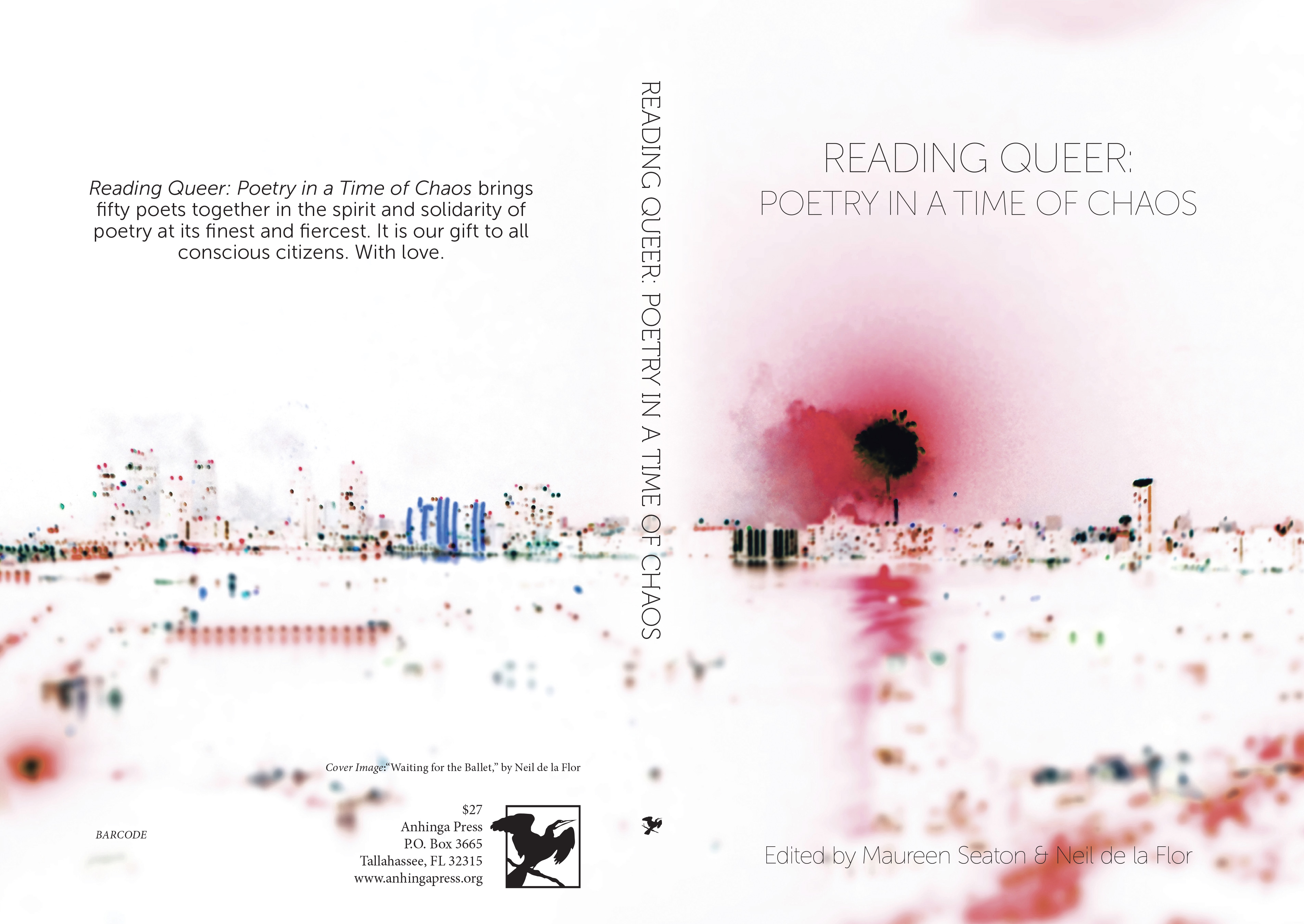
Reading Queer: Poetry in a Time of Chaos, edited by Neil de la Flor and Maureen Seaton, is a collection of the most subversive, gritty, moving, and courageous writing to come out of the U.S. queer community in recent political times. ”When we started to solicit material for the anthology in 2015,” says Seaton & de la Flor, ”we didn’t expect to compile a survival manual. Overnight, the work of these fifty poets became even more crucial. It became sacred.” Reading Queer: Poetry in a Time of Chaos brings the LGBTQI community together in the spirit and solidarity of poetry at its finest and fiercest. ”It is our gift to all conscious citizens. With love.” (Seaton & de la Flor).
An Elephant’s Memory of Blizzards | Marsh Hawk Press | 2013

In An Elephant’s Memory of Blizzards, Neil de la Flor takes on the inefficacy of gendered and hetero-sexualized expectations in the modern age. As the poem ‘Shiva’ points out, ‘Somewhere between male and female, the soul lives unstirred by the memory of childhood // ….Somewhere between Terminal 2 and Terminal 3, the soul lives in a million humming humans who will pass through O’Hare in the third person.’ Inspired in part by music and popular culture, de la Flor employs a brilliant aesthetic sprawl that teems with anaphora and bright imagery; yet within that, there is a rigorous (and ultimately elegiac) interrogation of reality. Pronouns are not to be trusted. You and I can be as close as a spliced consciousness, yet the we is not a harmonious plural. Personalities divide. Alternative memories emerge. Love is a code for lust, one speaker claims, but these poems never settle for hormones and juices. This collection is fierce. —Sandra Beasley
Two Thieves & a Liar, Jackleg Press | 2012

Purchase > here.
The JackLeg Press Poetry Series Storming the genders of Americanismo with crossed fingers and sans rules, these poems contradict the text by adding values and filling out applications. Two voices and three voices are threaded to one and the resulting operatic tool digs up the shades of birds, mathematics, riots, and catastrophe. Experience a disturbing disintegration of authorial identity. Experience that identity reshape and reassemble as an intelligent chimera that stares you in the face with as many faces as you can imagine. — Natalija Grgorinic & Ognjen Raden When I interviewed these three authors about how they “did” it, that is to say, collaborate, it wasn’t like I received three sets of answers. Group mind groped, it was like talking to the tank. — Terese Svoboda
Sinéad O’Connor and her Coat of a Thousand Bluebirds, Firewheel Editions | 2011
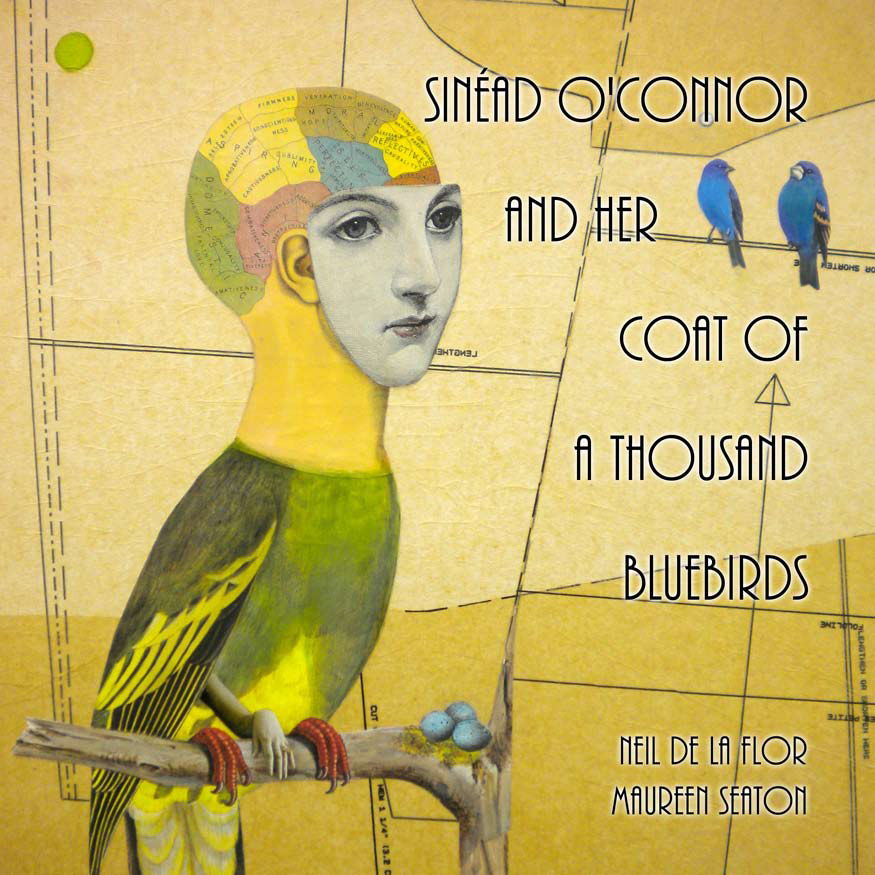
This book is not about Sinéad O’Connor or the gathering impulse of blue birds or the rotten plans of serge-robed men or Aunt Foxy’s potted peppers. Even we, its progenitors, will see this book on a shelf somewhere someday and think: Now we will learn all there is to learn about Sinéad O’Connor and her coat of a thousand bluebirds, having forgotten the way human beings forget the importance of remembering. But Sinéad will always remain the ethereal Sin‚ad, and the path to the shorn woman with the songbird’s throat will remain (un)regrettably undetectable.
This is a book about songs. Detectable as blue birds against a white wall against a memory board that contains the only record of Bette Davis moshing. It’s about Steve and Hector or impressions of them stumbling through storm weather. But it’s really not about them, or their teddy bears. It’s about our personal interior landscapes that fracture and wind around each other like a tornado winds around the wind. This book is about weathermen and pink-eyed women. And thermospheres. We have no idea what this book is about. Ask Sallie.
Almost Dorothy | Marsh Hawk Press | 2010
Purchase > here.
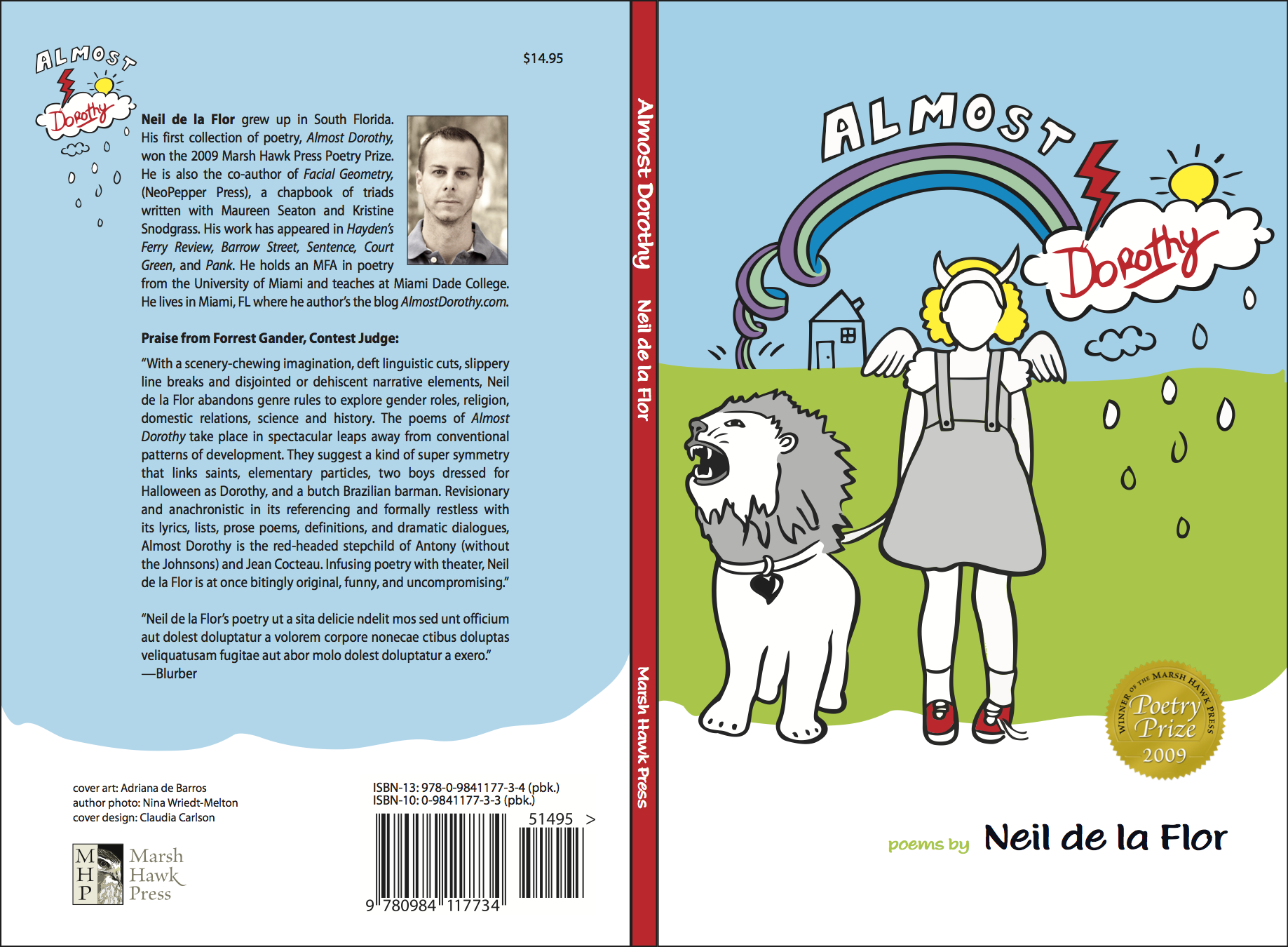
Winner of the 2009 Marsh Hawk Poetry Prize. Praise from Forrest Gander, Contest Judge: “With a scenery-chewing imagination, deft linguistic cuts, slippery line breaks and disjointed or dehiscent narrative elements, Neil de la Flor abandons genre rules to explore gender roles, religion, domestic relations, science and history. The poems of ALMOST DOROTHY take place in spectacular leaps away from conventional patterns of development. They suggest a kind of super symmetry that links saints, elementary particles, two boys dressed for Halloween as Dorothy, and a butch Brazilian barman. Revisionary and anachronistic in its referencing and formally restless with its lyrics, lists, prose poems, definitions, and dramatic dialogues, ALMOST DOROTHY is the red-headed stepchild of Antony (without the Johnsons) and Jean Cocteau. Infusing poetry with theater, Neil de la Flor is at once bitingly original, funny, and uncompromising.”
Facial Geometry, NeoPepper Press | 2006

A liteary equivalent of having a couple of friends over, Facial Geometry, co-authored by Neil de la Flor, Maureen Seaton and Kristine Snodgrass, is an invitation to run the gauntlet of hilarity where every word is a whip-sharp feather. Experience a disturbing disintegration of authorial identity. Experience that identity reshape and reassemble as an intelligent chimera that stares you in the face with as many faces as you can imagine. ―NeoPepper Press
The poets translate throughout the book, retooling the edge of cognition right up to the funny or sad, engage cheekbone to cathedral buttress, and infer that the DAR are playing too. No convulsive personal revelations here. The chapbook’s handsome three-eyed cover gives you the once-over at first glance. It won’t be your last. Besides, I haven’t even told you about ‘Planet Napkin’ or ‘The Pekinese Journal’. ―Terese Svoboda
Download a copy > facial geometry.
 Neil de la Flor